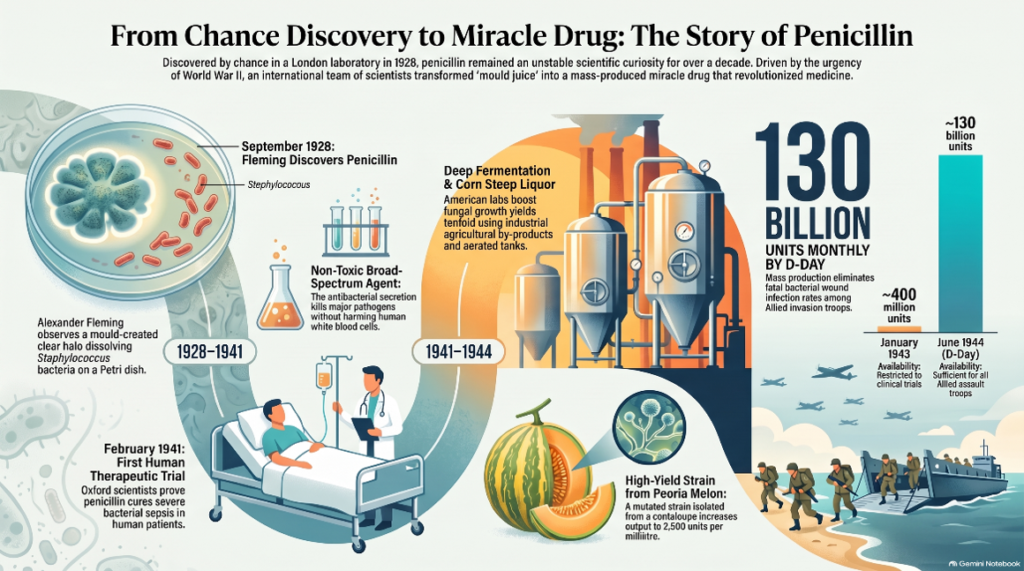
Every Scottish schoolchild gets to hear the story of Alexander Fleming discovering Penicillin, as a result of fungal spores from a rotting melon landing on a petri dish containing bacteria, and killing the bacteria…and the rest is history, as they say. But just exactly what do they say? Because I’ve never heard the rest of that story. Until now.
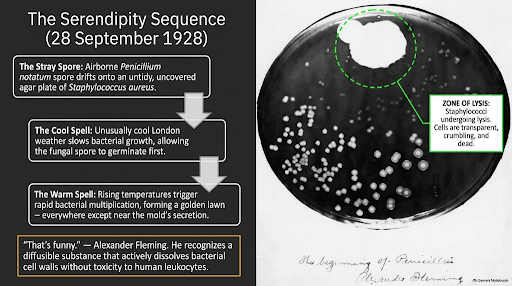
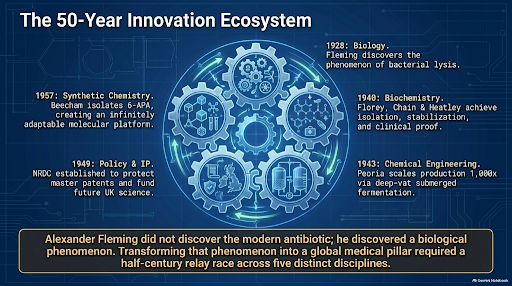
It turned-out that Fleming couldn’t do anything with it. In 1928, progress eluded him. He did try, but the Penicillin didn’t last long, and nothing could be done. Being the scientist that he was, he published all his notes from his research, and put the samples away, where they stayed on a shelf for over 10 years.
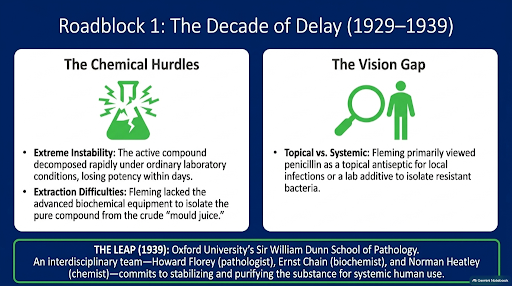
In 1939, a team consisting of Howard Florey (pathologist), Ernst Chain (biochemist) and Norman Heatley (chemist) picked-up on the work done by Fleming, realising the potential, and began working on a project to stabilise and purify new samples grown in the laboratory.
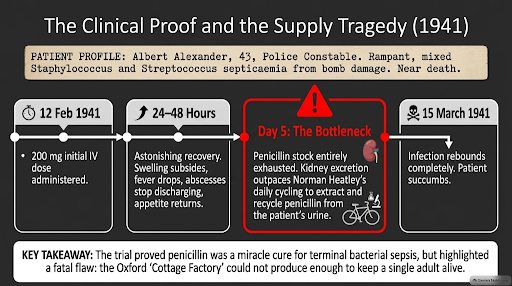
By the time that work got underway, World War 2 was being fought, and many people were being injured in London, from the bombs being dropped in London. In the course of their lab work, the team were able to succeed in their stabilisation objectives, and went on to prove that penicillin was seemingly a miracle cure for humans, causing a reduction in both infection and inflammation, and producing astonishing recoveries. But they ran into a new problem, where their facilities were just too small to produce the large quantities needed, both to cure the patients, and to continue their investigative work.
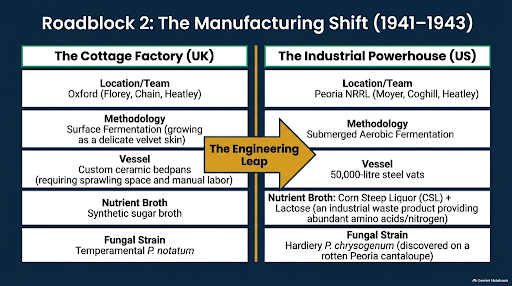
The team of scientists moved to the USA to work within much larger facilities, managing to occupy a factory, which was not possible in England as every factory was working full scale to produce planes, tanks, bombs, guns, ammunition and every other supply item for the American military, as they were now in the war too, having been attacked by the Japanese in Pearl Harbour.
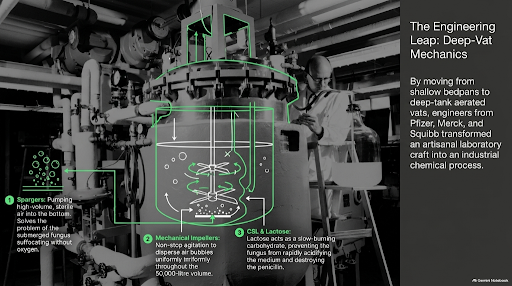
The new team essentially created a ‘brewery’, using 50,000 litre vats for a methodology of submerged aerobic fermentation, as opposed to trying to grow cultures in ceramic bedpans in Oxford.
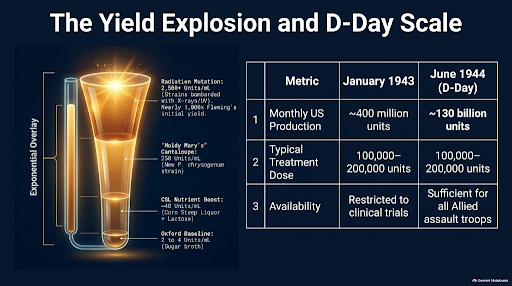
At this point, in 1943, the allied forces in the war were beginning to plan the D-Day invasion of Normandy, but every scenario envisaged was likely to cause enormous fatalities as a result of infection setting-in to wounds suffered from the military action. When they heard about the work of the scientists, they wanted production to increase from the 400 million units created for clinical trials to 130 billion units, which they felt would be sufficient for the treatment of all allied assault troops, and thereby hugely decrease the fatalities arising from the planned action.
The D-Day landings were successful militarily, and the penicillin did the job of saving very many soldiers who would otherwise have died eventually from their wounds.
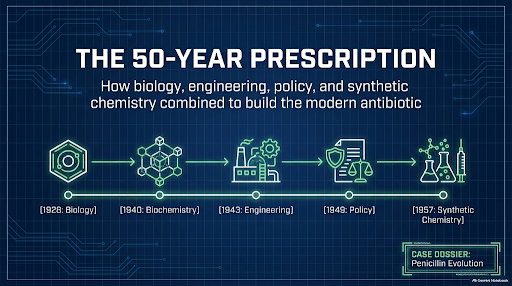
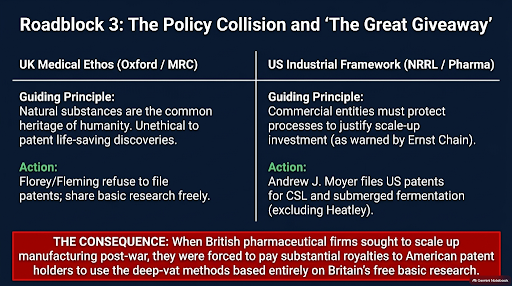
After the war was over, and the bills needed to be paid, and the Americans wished to recoup their investment, they took advantage of the fact that the British scientists felt it immoral to seek payments for discoveries that would benefit humans, and whilst they could not patent Penicillin itself, as discovered by British, not Americans, they found that they could patent the manufacturing processes used in the American labs, the result of which meant that the British had to pay large sums of money to the Americans to produce penicillin at the scale needed to treat the population.
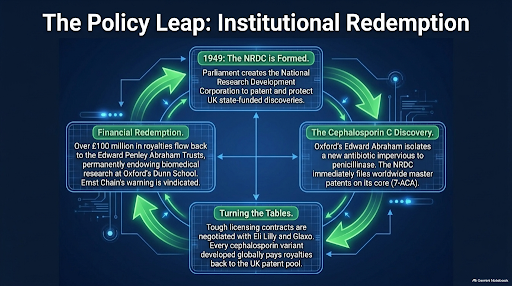
Needless to say, the UK government was furious over this development, and in 1949, they formed the National Research Development Corporation (NRDC) to protect all future discoveries within British universities. This eventually paid-off when Penicillin began to face resistance from Staphylococcus Aureus bacteria, and the new strain of Cephalosporin was developed in UK labs to combat this problem. Thus, when other countries developed their own version of Cephalosporin, they had to pay royalties back to the UK government.
Cephalosporin was only the first part of the evolutionary journey, as the bacteria continued to cause resistance. By 1957, the scientists had produced Methicillin to continue that fight. Needless to say, there is a lot that was done in labs which I am skipping over, such as the biochemistry involved in the continuous development of these drugs, but if that is something you are curious about, there is a wealth of material for information with simple internet searches, enhanced as required by AI.
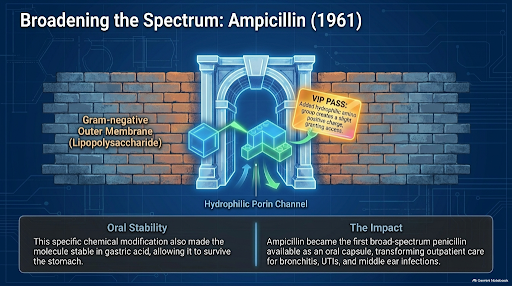
In addition to fighting resistance to Penicillin, the scientists were also developing ways of fighting many different kinds of bacteria, rather than mostly Staph-Aureus infections. And in 1961, Ampicillin was developed as the first ‘broad spectrum’ form of penicillin available to take as a capsule for many different conditions.
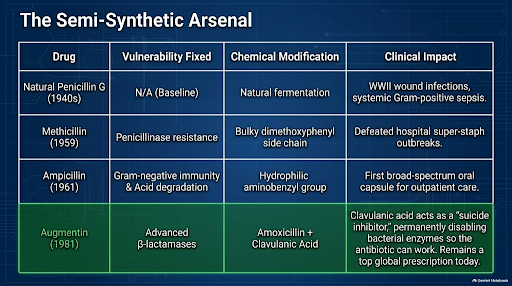
In 1981, Augmentin was made available, and is still used today, and I have had my fair share of that, too (eg. Co-Amoxiclav). This is a combination (hence ‘co-’) of Amoxicillin and Clavulanic Acid, which was being developed throughout the 1970’s after being discovered in a lab in 1974. The Clavulanic Acid disables bacterial enzymes being produced when met with the Amoxicillin. This then allows the antibiotic to work.
It is important to know that antibiotics act against bacterial infections, and do nothing for viral infections. This seems to continue to confuse the wider population, despite decades of education to that effect, and despite the country having experienced a major viral infection pandemic in the shape of Covid.
As a child, I was given very large amounts of Ampicillin to fight off constant chest infections and Asthma attacks during pre-Ventolin days, along with oral cortico-steroids; and that has caused a number of immune system problems for me as an older adult, along with steroid damage to eyes, kidneys, liver, adrenal glands and pancreas, and some other chronic health and mobility conditions just to keep them company. Of course, no-one knew then what they know now, and prescribing like that would never take place nowadays. For myself, I try very hard to avoid infection as an older adult, taking whatever vaccinations are on offer (Flu vax this morning), and inhaling small doses of preventative steroid for Asthma, and because I am steroid-dependent.
When I have problems nowadays, I am usually given an Augmentin prescription initially. If two rounds of that doesn’t work (increasingly the case), I am then given Tetracyclic antibiotics, such as Doxycycline where their initial action is to prevent the bacteria from producing proteins, which then prevents growth of the bacteria.
Thus, to round-off this story which I have partly lived, through my health history as one of the guinea pigs along the way. I am so grateful for the development of antibiotics to the state they are in now because, despite the damage they may have caused me, I would not be here writing this account now because I would surely have died some time ago. So, antibiotics have kept me alive including, and perhaps especially, when I was hospitalised in 2019 with both viral flu and bacterial pneumonia. They continue to help me when I develop infections like Cellulitis.
Little did I know as a child in primary school, hearing about Alexander Fleming for the first time, what effect that discovery would have, and continues to have, upon the whole of my life.
Fraser
AI Contribution: All graphics and video (see below)