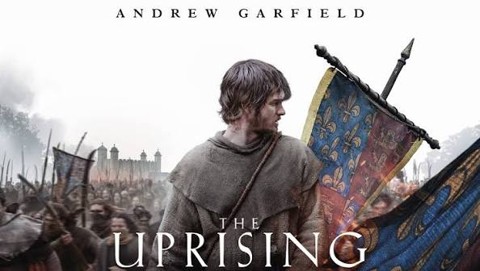
19 October 2026 – Cinema Club met at one member’s house to see ‘The Uprising’ today. The synopsis of the film was as follows:
“Based on the true story of the uprising that inspired the legend of Robin Hood, Andrew Garfield stars as the leader of a rebellion against the tyranny of King Richard II in a fight for justice.”
This synopsis questions the Victorian interpretation of the origins of Robin Hood, suggesting that the ‘ploughman’ story told is that of the origins of Robin Hood, which is going to be confusing for any audience not aware of several interpretations of that story. And the story was additionally historically questionable, as most historians agree that the uprising was led and initiated by Wat Tyler, not by an unknown ploughman, and that is not fully acknowledged in this film; and whilst Tyler was put to death for his part in the uprising, most historians agree that there was no wholesale slaughter of those protesting, so there is quite a degree of historical ‘licence’ being taken with the events as outlined.
The film was slow to start, and felt quite boring, but once it got going with action, there were many scenes of relentless violence, which seemed a rather extreme way of telling the story. And the whole thing felt like a way of taking some half truths and turning them to the advantage of the film-maker who seemed intent on using extreme violence to tell his story.
The leading members of the cast were: Andrew Garfield, Jamie Bell and Stephen Dillane; and the film was directed, and screenplay written, by Paul Greengrass, who also directed ‘Ressurected’, ‘Open Fire’, ‘The One that got away’, ‘Bloody Sunday’ and ‘The Bourne Supremacy’.
The plot, setting and acting were not great, but equally, not terrible. I was irritated by the conflation of an interpretation of the origin of the Robin Hood myth and the peasants’ revolt led by Wat Tyler, and it seems to me unlikely to win any awards, but I suppose, despite its mediocrity, it might serve as informative to some degree to those who don’t know any of either story at all. My 3 companions felt the level of violence was somewhat extreme, but felt that a good story had been conveyed. One of them described the film, accurately in my opinion, as “harrowing”.
Mark Kermode reflected that Paul Greengrass, the director of the film, considered the peasants’ revolt then, to be in parallel with Brexit, considering both to be a cry for social and economic justice. And he (the director) made the film to show what happens when the powerless rise up to make such demands, which is seemingly that they don’t get what they expect, and continue to feel powerless.
Kermode describes the film as having a main ‘Everyman’ character, serving to place the audience into the middle of the powder keg of resentment. He also described the film as “confusing, depressing and having no happy ending”.
I gave it a score of 6, whilst IMDB gave it 6.2, and the Rotten Tomatoes score was 5.6 (56%).
Fraser
AI Contribution: Claude provided a summary of UK reviews, which was then edited and checked for accuracy by Microsoft Copilot (see below). No human verification took place.
Please provide a full summary of UK film reviews of the 2026 film ‘The Uprising’, showing sources….
UK Reviews of The Uprising
Overall verdict: UK reviews were mixed, with most critics placing Paul Greengrass’s historical drama around the three-star mark. The film opened in the United States on 11 September 2026 and in the UK on 9 October. Reviewers consistently praised Andrew Garfield’s committed central performance, the physical force of the action and the story’s contemporary resonance. The main objections were the relentlessly muddy visuals, Greengrass’s restless handheld camerawork and an awkward Robin Hood-inspired ending.
Where critics agreed
- Garfield is the film’s strongest asset. Empire called his performance fearsome and magnetic, while The Scotsman said he grounds the drama with righteous fury. Even less enthusiastic reviews generally found him stirring or committed.
- The style is immediate but divisive. Film Review Daily admired the documentary-like urgency and the contrast between peasant squalor and royal splendour. Other reviewers found the shaky camera, rapid cutting and drab palette tiring or difficult to follow.
- The modern parallels are unmistakable. Critics repeatedly connected the revolt’s taxation, inequality and political anger with present-day Britain. Some found that relevance powerful; others thought the film stated it too bluntly.
- The ending is the principal weakness. Several reviews argued that the Robin Hood material feels grafted on, historically strained or tonally at odds with the rest of the film.
Range of opinion
- Strongly positive: Empire awarded the film four stars, praising Greengrass’s controlled chaos and arguing that Garfield has seldom been better. The Sunday Times, as listed by Rotten Tomatoes, also awarded four stars and described it as highly enjoyable cinema.
- Qualified approval: Time Out, The Scotsman, Movie Marker and Flickering Myth clustered around three stars. They admired the performances, production design, action and relevance, but found the drama uneven and the finale clumsy.
- Negative: The Guardian’s US review called the film a disjointed slog, while its later UK review found the Robin Hood framing disconcertingly silly. Sight and Sound thought the hurried debates weakened character development; Screen Daily found the film listless despite Garfield; and The Movie Waffler criticised both his performance and the confusing action editing.
Additional UK coverage: Rotten Tomatoes lists reviews by Wendy Ide in The Observer and Hadley Freeman in the Sunday Times. Ide emphasised the film’s contemporary resonance but found the viewing experience unpleasant; Freeman was notably more positive, awarding four stars. These assessments are based on the review extracts reproduced by Rotten Tomatoes.
Wider critical picture: The response was mixed rather than broadly positive. At the time checked, Rotten Tomatoes recorded 56% positive reviews from 121 critics, while Metacritic reported a score of 56 from 39 reviews. The Irish Times gave the film two stars, arguing that Greengrass’s usual command of propulsive violence had deserted him.
Verified sources
- Focus Features — official US release announcement
- Official UK website — UK release date
- Empire
- Time Out
- The Guardian — US review
- The Guardian — UK review
- Sight and Sound / BFI
- Screen Daily
- Rotten Tomatoes
- Metacritic
- Irish Times